Telemedicine Hospitalist Care: How Remote Physicians Support Hospital Teams
Telemedicine hospitalist programs can extend physician access across a hospital or health system, but a video connection alone does not define a workable model. Leaders evaluating telemedicine hospitalist care need to understand how remote physicians connect with bedside teams, what examination support is available, and where clinical responsibility and escalation boundaries sit.
What does telemedicine hospitalist care mean?
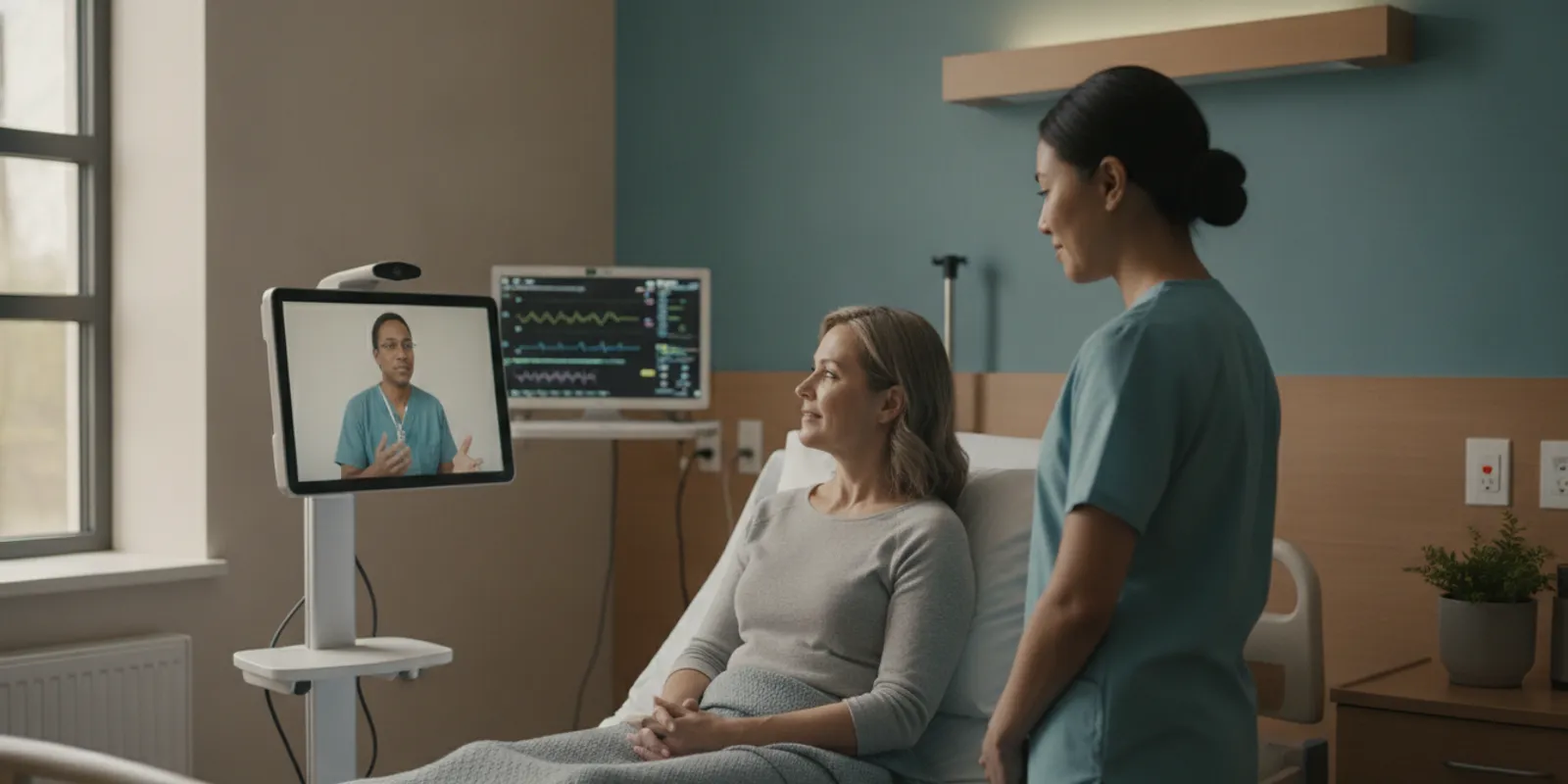
A telemedicine hospitalist model uses remote physician participation to support hospital-based care. The exact arrangement varies. A remote hospitalist may assess a patient, collaborate with an on-site nurse, help coordinate a plan, or support after-hours access. The clinical coverage model, staffing arrangement, and technology are separate decisions: a platform can enable a remote encounter, but it does not by itself determine who is responsible for providing physician coverage.
That distinction matters during evaluation. Hospital leaders should first define the care gap they want to address. Is the problem limited access to a hospitalist at certain hours? Is a facility trying to connect a remote physician to patients in different locations? Does the bedside team need a way to bring a clinician into a room without moving the patient? Each answer points to different staffing, workflow, and technology requirements.
Research and professional discussion of telehospitalist services have considered implementation settings, staffing models, and how service performance compares with standard hospitalist program measures. Those are useful prompts for an evaluation, not proof that one model or platform will fit every hospital. A review of new hospital telemedicine services describes the potential market for telehospitalist services and identifies performance evaluation as an area for further research. The Society of Hospital Medicine's telemedicine-for-the-hospitalist education resource also emphasizes different clinical settings and staffing models.
How can a remote hospitalist work with the bedside team?
Remote participation works best when the bedside and remote clinicians have a shared understanding of the encounter. The remote physician needs a clear way to learn why the patient needs attention, who is physically present, what has already been assessed, and what response the team expects. The bedside clinician needs to know how to connect the physician, share observations, and carry out or clarify the plan.
A practical encounter can be organized into a few repeatable steps:
- Identify the need. The on-site team records the reason for the request, the patient's location, relevant urgency, and whether an immediate in-person response may be needed.
- Connect the right people. The remote physician, patient, and bedside clinician join the encounter. The nurse or other on-site team member helps orient the physician to the room and the patient's immediate situation.
- Share context. The team communicates the presenting concern, available observations, pertinent history, and any steps already taken. The remote physician confirms the information needed to proceed.
- Conduct the encounter within scope. The physician performs the parts of the assessment that can be completed remotely, requests appropriate bedside assistance, and identifies what cannot be assessed adequately through the connection.
- Agree on next steps. The team confirms the plan, ownership of actions, documentation responsibility, and conditions that should trigger an in-person or higher-level response.
This is a workflow outline, not a clinical protocol. Each organization must align it with its medical staff policies, patient population, available on-site resources, and emergency procedures. A remote clinician should not be expected to infer that a patient is stable simply because a video connection is available.
What response-time questions should leaders ask?
“Available” can mean several different things: a clinician is scheduled and ready, a request has been received, a call has been answered, or a patient encounter has begun. Define the event being measured before comparing options. Ask vendors and clinical leaders to describe the complete path from request to meaningful physician interaction, including any handoffs or delays outside the technology.
- When does the clock start? Specify whether measurement begins when a need is identified, a request is entered, or a clinician is paged.
- Who acknowledges the request? Establish who monitors requests, how the bedside team knows the request was received, and what happens if no one responds.
- What hours and locations are covered? Confirm the proposed clinical coverage schedule and where the workflow is intended to operate. Do not assume that a technology demonstration establishes staffing availability.
- What is the fallback? Define the route to an on-site clinician or emergency response when a remote clinician is unavailable, the connection fails, or the patient needs immediate hands-on care.
- How will exceptions be reviewed? Decide how to record and investigate delayed connections, repeat requests, and cases where remote assessment was not sufficient.
Response targets should be set by the organization and its clinical leadership, based on the intended use and coverage model. A platform's connection capability is not a substitute for an agreed clinical response standard. For comparison, the professional discussion in The Hospitalist's overview of evolving hospitalist roles in telemedicine describes remote support in settings that can include rural, isolated, or understaffed hospitals. The point for an evaluating organization is to match the model to its setting and define how coverage functions in practice.
What bedside examination support is needed?
Leaders should distinguish a conversation by video from a remote clinical encounter that gives the physician useful views, observations, and connected information. Ask clinicians to map which portions of their intended assessment can be completed remotely, what requires a person at the bedside, and what requires direct examination by an on-site clinician.
For each use case, consider:
- Visual access: Can the remote physician see the patient and relevant parts of the room clearly? Can the bedside team reposition the view as needed?
- Patient communication: Can the patient hear and understand the clinician, and can the patient participate comfortably? Plan for cases where the patient needs assistance communicating.
- Bedside assistance: Which observations or examination steps depend on a nurse or other qualified team member being present? Clarify what assistance is appropriate and how it will be documented.
- Connected devices: If vital-sign devices are part of the proposed workflow, identify the devices, how readings reach the clinician, and how the result is recorded. Do not assume every device or data flow is supported.
- Limits: Agree on situations in which the remote clinician cannot make an adequate assessment and must request an in-person evaluation or another response.
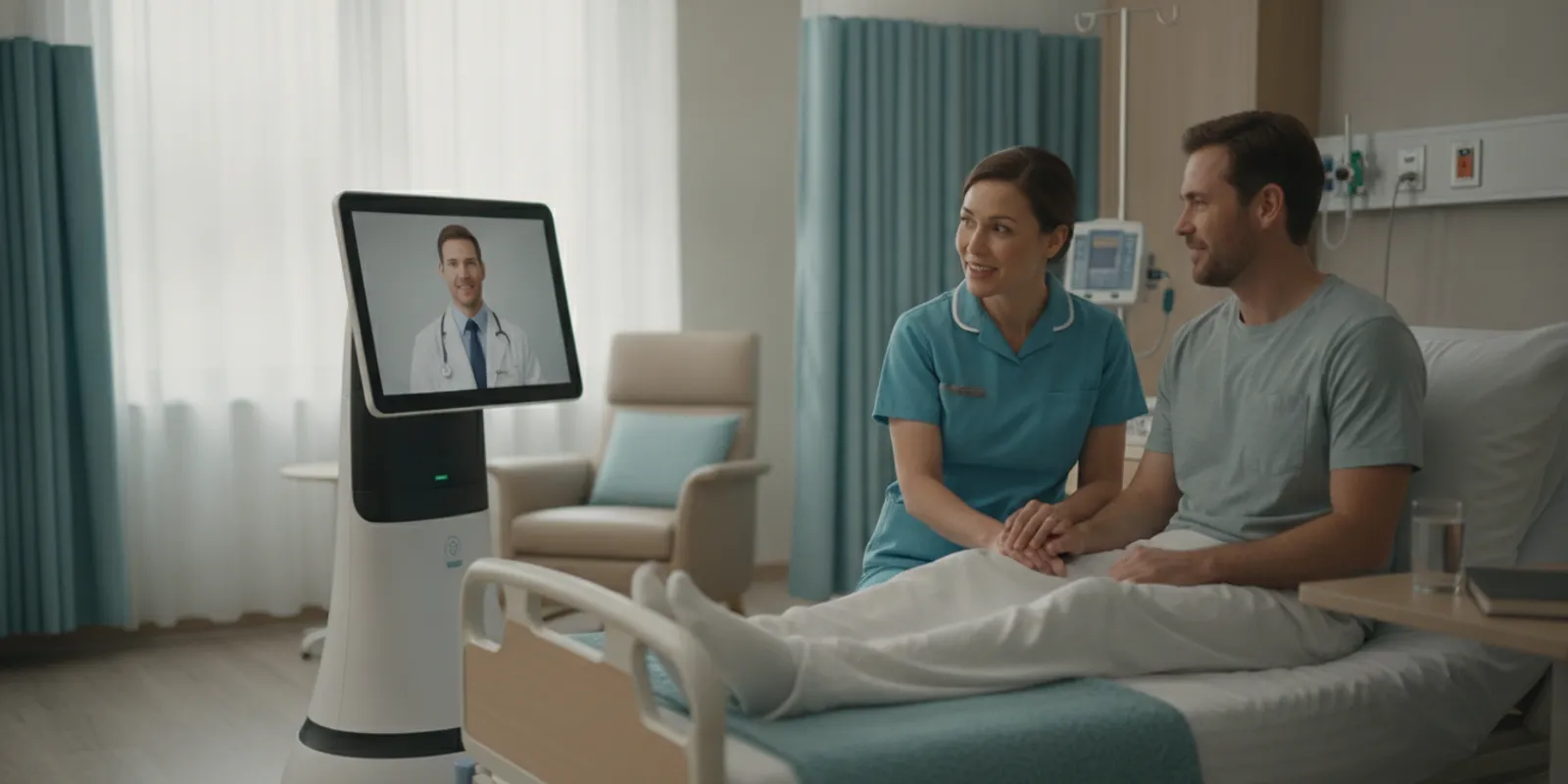
Dr. Temi is a healthcare technology platform for autonomous robotic telepresence, rather than a hospitalist staffing service or generic video-call application. Its stated approach is to bring a remote physician to the patient's bedside through a self-navigating robot, without requiring staff to transport or position equipment. The platform supports live clinical encounters and connected vital-sign devices; the care organization remains responsible for determining the appropriate clinical use and staffing model. Learn more about the company's telemedicine and other care solutions or its broader approach to autonomous clinical care.
How should nursing workflows and collaboration be designed?
Remote physician access changes how a bedside request is initiated and supported. It should not create an unclear extra task for nurses or assume that a nurse can step away from other responsibilities whenever a remote consult begins. Involve nursing operations early, and test the workflow with the people who will use it during real shifts.
Map the process from the nurse's point of view. Who decides that a telemedicine encounter is appropriate? How is the request communicated? What information is ready for the physician? Who helps the patient connect? What does the nurse do during the assessment, and who documents the encounter? The answers should be explicit enough that staff can use the process consistently without relying on informal workarounds.
Also examine how the workflow handles competing demands. If the nurse is assisting another patient, can another authorized team member help establish the connection? If the patient cannot operate a screen, what support is available? If the remote clinician requests a bedside observation, is the person present trained and authorized to assist? These are operational questions for the facility to resolve, not features a video device can answer.
For autonomous robotic telepresence, evaluate whether mobility changes the steps staff must perform. Dr. Temi's model, described on the company homepage, is designed to navigate to a patient rather than requiring staff to push and position a traditional cart. During a demonstration, observe how a request is initiated, how the robot reaches the room, and how staff know the encounter is ready. Then test relevant room, network, access, and cleaning procedures with local teams. The goal is to understand the actual workflow, not presume that autonomy removes every implementation responsibility.
Where should escalation boundaries sit?
A remote hospitalist workflow needs an agreed boundary between care that can proceed remotely and situations that require a different level of response. Boundaries should be created by the organization's clinical leadership and applied consistently. Technology may help a remote clinician see and communicate with a patient, but it cannot replace local emergency procedures, professional judgment, or hands-on care when those are needed.
Before launch, clarify who can request an escalation, who responds on site, how the remote physician communicates the concern, and how the event is documented. Include connection failure and unavailable clinician scenarios. The team should know how to move to an approved alternative without waiting for a technology issue to resolve.
Set expectations for decision ownership as well. Establish who is responsible for the assessment, orders, follow-up, and communication with the patient or family under the selected coverage arrangement. Confirm how the remote physician's work fits medical staff bylaws, credentialing and privileging processes, applicable policies, and the organization's documentation standards. These details depend on the institution and its model; a vendor cannot define them on the hospital's behalf.
How do telemedicine hospitalist options compare?
Different approaches can support different needs. The table below is a decision framework, not a rating of vendors. Confirm the details of any proposed service or device with its provider and clinical stakeholders.
| Approach | What it can support | What leaders should verify | Potential operational consideration |
|---|---|---|---|
| Remote physician by standard video | Remote discussion and visual interaction when a patient and local team can access the connection. | Coverage schedule, request process, image and audio quality, device access, and fallback route. | A staff member or patient may need to set up and position the device. |
| Telemedicine cart or fixed video station | A dedicated room-to-room or unit-based connection, depending on the equipment and workflow. | Where the cart is stored, who transports it, how it is cleaned, and whether it can reach the patient in time. | Movement and positioning can add steps for on-site staff. |
| Autonomous robotic telepresence | A remote clinician can connect through a robot designed to navigate within a facility to a patient's location. | Navigation conditions, connectivity, access controls, device capabilities, staff procedures, and clinical use boundaries. | The facility should test navigation and operational fit in its own spaces and workflows. |
| On-site hospitalist coverage | In-person physician presence for activities that require a clinician physically at the facility. | Coverage hours, staffing arrangements, handoffs, and how remote support complements on-site care. | It is a staffing and care-delivery model, not simply a technology choice. |
These approaches are not necessarily mutually exclusive. Some organizations may use remote encounters to complement local clinicians, while retaining on-site response pathways. The right comparison is against the specific access problem, patient population, staffing plan, and clinical policy, not against a generic promise of convenience.
What should implementation include?
Implementation should bring clinical, nursing, operations, IT, security, and executive stakeholders together early. Hospital medicine leaders can define clinical use cases and coverage needs. Nursing leaders can test the bedside process. IT and security teams can review network and access requirements. Operations can plan device placement, cleaning, and support. Executives can set goals and determine what evidence is needed to continue or expand a program.
A staged plan can make decisions more manageable:
- Define the use case. Specify patient groups, locations, hours, and the access issue the program is intended to address. Separate the clinical coverage plan from the technology selection.
- Map current workflow. Document how the bedside team currently requests physician input, how long each handoff takes, and where delays or unclear ownership occur. Use local observation rather than assumptions.
- Set policies and roles. Establish request criteria, clinical responsibilities, escalation procedures, documentation, and the response if technology or clinician availability is interrupted.
- Review technical fit. Assess network coverage, user access, device management, integrations, privacy and security requirements, and support processes. Ask vendors to demonstrate the workflow in relevant conditions.
- Train and test. Include physicians, nurses, support teams, and the people who manage devices. Use simulations to test routine and exception scenarios before relying on the workflow in care.
- Evaluate a defined launch. Select an appropriate initial scope, decide how feedback will be collected, and set a review date with clinical and operational stakeholders.
For autonomous robotic telepresence in particular, a demo should answer practical questions: How does the clinician initiate an encounter? How does the robot navigate to the bedside? What happens if a route is blocked or the network is unavailable? What must staff do before, during, and after a visit? Which connected devices and workflows are in scope? What data are available for documentation or review? Dr. Temi describes its live calls as encrypted and not recorded or retrievable, with access restricted to credentialed users. A hospital's own privacy, security, and procurement teams should verify that these supported claims and the proposed configuration meet its requirements.
How can leaders assess whether the model is working?
Choose measures before launch and pair operational indicators with clinical and staff feedback. A program can have a functioning connection but still fail to fit the care team's needs. Conversely, a small number of encounters may be appropriate if the program is intended for a narrowly defined use case. Interpret measures in context and avoid treating a single metric as proof of clinical benefit.
- Access and response: Track requests, acknowledgments, completed connections, and the time between clearly defined workflow events.
- Encounter completion: Review how often the remote interaction proceeds as intended, requires a different mode of care, or ends because of a technical or clinical limitation.
- Workflow burden: Ask bedside staff and remote clinicians about setup steps, interruptions, role clarity, and documentation effort.
- Escalation and safety: Review whether escalation pathways were used appropriately and whether teams could move to a fallback process when needed.
- Patient experience: Gather feedback on communication, comfort, and accessibility using the facility's established methods.
- Program fit: Compare actual use with the stated purpose, coverage plan, and resources committed to the program.
Where appropriate, compare these measures with the organization's existing hospitalist program indicators. Define denominators and exclusions, protect patient information, and have clinical leaders interpret results. The literature on telehospitalist services highlights comparison with standard hospitalist program metrics as a question for continued evaluation; it does not establish that results will be the same across facilities or models.
What should your evaluation team ask before a demo?
Invite the people who will own the workflow, not only the technology selection. Ask the clinical lead to describe a representative encounter from request through documentation. Ask nursing operations to identify steps that require bedside staff. Ask IT and security to review connectivity, user access, device behavior, and information handling. Ask executives to confirm the problem to solve and how the organization will judge fit.
- Which patient-care situations are in scope, and which are explicitly out of scope?
- What clinical coverage model provides the remote physician, and how does coverage vary by time or location?
- How are requests acknowledged, and what is the fallback if the physician or technology is unavailable?
- What can the remote clinician see or assess, and when is an on-site examination required?
- What work is expected from nurses and other bedside staff during a typical encounter?
- How do credentialing, documentation, EHR workflows, privacy, security, and support fit the facility's requirements?
- Can the team test the system in its intended rooms and simulate both routine and exception cases?
- Which measures will be reviewed, by whom, and when will the organization decide whether to adjust or expand the program?
Dr. Temi's solutions overview provides context on the platform's care applications. Hospitals exploring facility-based programs can also review the Rural Healthcare Access Program if it is relevant to their setting; eligibility and reimbursement should be confirmed rather than assumed.
Telemedicine hospitalist care is most useful to evaluate as a combined clinical, staffing, and workflow decision. Define the intended role, test how remote physicians and bedside teams will collaborate, and establish clear boundaries and measures before choosing a model.