Telemedicine Consent Requirements for Hospitals

Telemedicine consent requirements for hospitals are not one national form. A bedside video visit can be lawful in one state with a verbal note and incomplete in another without a documented discussion. Hospital leaders need a workflow that proves the patient understood the visit, agreed to it, and could take part.
This guide is operational, not legal advice. Counsel should confirm the rule for each state, payer, and service line before a policy goes live. The sections below cover the questions a consent workflow has to answer.
What telemedicine consent requirements for hospitals cover
Consent to the mode of care does not replace consent for the treatment itself. A patient can agree to a video visit and still need a separate discussion before a high-risk treatment. HHS tells clinicians to explain the visit, the patient's rights, and any observer before care starts. That guidance was last updated on August 18, 2023, on Telehealth.HHS.gov.
A useful hospital policy names four decisions before the first live visit:
- Who explains telemedicine, and in which language or format.
- Whether consent may be verbal, written, or both for that service.
- Where the agreement is stored, and who can see it later.
- What happens if the patient refuses video, audio, or an observer.
The Center for Connected Health Policy reported on August 11, 2026, that most states put some telehealth consent rule in statute, administrative code, or Medicaid policy. The same rule may cover only Medicaid, one specialty, or every telehealth visit. Medicare's consent rule is narrower. It applies to communication technology-based services, and the patient must be told about cost sharing. Consent for those services can be verbal, noted in the record, and renewed once a year.
Do not copy a clinic's outpatient script into the emergency department and call it done. A scheduled clinic visit, a stroke alert, and a nursing-home bedside consult raise different questions about who can speak for the patient.
How state and payer rules change the workflow
State law, Medicaid manuals, Medicare rules, and commercial contracts can all apply to one encounter. A multi-state system should keep a dated matrix, not a single paragraph in the medical-staff bylaws.
| Source | What it may require | What a hospital should record |
|---|---|---|
| State telehealth statute | Verbal or written consent. Sometimes this is due before the first visit. | Patient state, clinician state, and the consent method. |
| Medicaid manual | A program-specific script. Some plans also require separate audio-only consent. | The payer, the modality, and the date consent was captured. |
| Medicare telehealth rule | Audio-only only in defined cases. Claims need specific modifiers. | Why video was not used. Note if the patient refused video or could not use it. |
| Medicare CTBS codes | An annual notice of cost sharing. Verbal consent is allowed. | The annual consent note in the beneficiary's record. |
| Commercial or health-system policy | A form that may be stricter than the statute. | The policy version the team actually used. |
California Business and Professions Code section 2290.5 was amended in 2025. The provider who starts telehealth must explain it and get verbal or written consent before delivery. That consent must be documented. Failure to comply is unprofessional conduct. The patient may still choose in-person care later.
The same statute lets a hospital grant telehealth privileges using information from the distant site. Consent and credentialing stay separate jobs. The privileging file is covered in Hospital Credentialing for Telemedicine.
Texas Occupations Code section 111.002, in effect since September 1, 2021, requires informed consent before telemedicine or telehealth. A physician, dentist, or other covered professional must obtain it from the patient or from a person authorized to decide. The statute does not publish one statewide form. The treating professional still owns the step.
California's Medicaid program adds a split that many hospital scripts miss. The Department of Health Care Services says consent may be verbal or written, but a patient who agrees to video must separately agree to audio-only care. A single "telehealth" checkbox can hide that choice.
Payer variation belongs in the same matrix. Reimbursement rules change which consent note a biller needs, but they do not replace the clinical discussion. The companion piece on payment is Telemedicine Reimbursement: A Practical Guide.
What the patient needs to understand
A signature is not proof of understanding. AHRQ describes the consent form as a record that a discussion happened and that the patient could grasp it. The practical test is whether the patient can say what will happen, who will be present, and what they can refuse.
Cover these points in plain language before the camera stays on:
- The visit is by video or audio, and an in-person option may exist.
- A remote physician may guide the exam while a local clinician stays at the bedside.
- Names and roles of everyone who can see or hear the visit, including trainees.
- What is not recorded. Dr. Temi's live calls are not recorded or retrievable. Say that only when it is true for the workflow in use.
- How to stop the visit, ask for a private moment, or request an interpreter.
- Any cost sharing the payer requires the team to disclose.
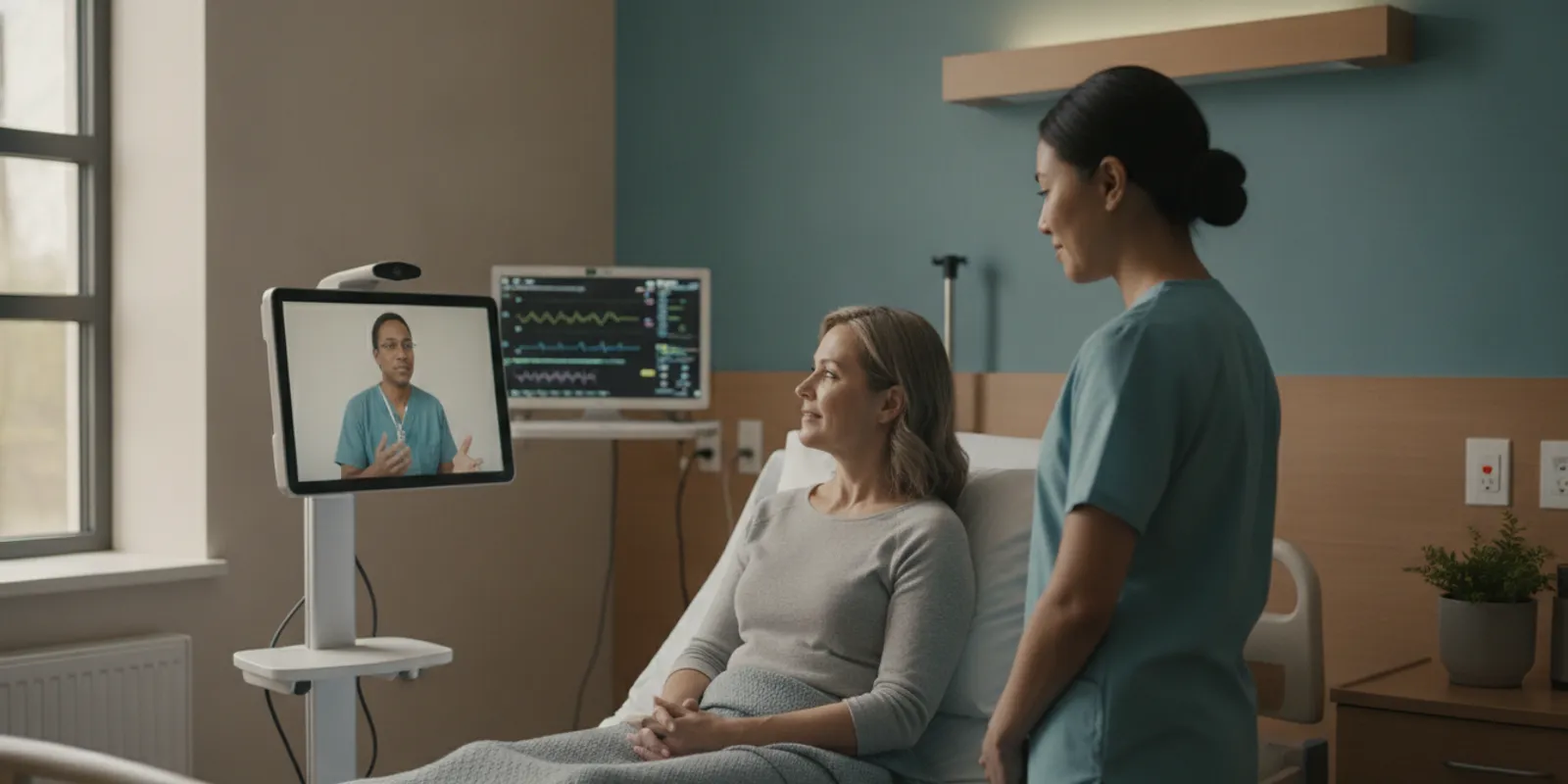
Bedside telepresence changes the picture. The patient is in a hospital or nursing unit, not at home. Staff may wheel a device to the bed and stay for vitals or hands-on help. Say that before the physician appears. On Dr. Temi's telemedicine workflow, the robot can open a secure bedside connection while on-site nurses assist. Consent should name that local role, not treat the visit as a private phone call.
If a family member, student, or second clinician will watch, HHS says to tell the patient and get consent at the start. A crowded room is not implied consent. Ask, then document the answer.
How to document consent so it holds up
Document the patient's choice, not just the existence of a form. Documentation should let a reviewer reconstruct the conversation without calling the nurse who worked that shift. Store the note where the care team and the billing team can both find it. A scanned form in a shared drive that never reaches the chart will fail an audit.
A complete note usually includes:
- Date and time, patient location, and clinician location.
- Modality: video, audio-only, or a switch from one to the other.
- Who gave consent, and their authority if not the patient.
- Language or auxiliary aid used.
- Whether anyone else observed, and that the patient agreed.
- The policy or script version, so later rule changes do not rewrite history.
Verbal consent is valid in many programs, including Medicare CTBS, if it is written into the record. Do not treat "patient agreeable" as enough. Name what the patient agreed to.
Audio-only Medicare telehealth is narrower. Under 42 CFR 410.78, two-way audio is allowed when the distant clinician can use video, but the patient is at home and cannot use video or does not agree to it. Claims then need CPT modifier 93. Rural health clinics and federally qualified health centers use modifier FQ. That home-based rule is not a waiver for every hospital unit.
Build the prompt into intake, not into a slide deck. Telehealth.HHS.gov recommends collecting forms before the visit and confirming them at check-in, including verbal consent. Have counsel review the intake language. Re-consent when the modality, the observer list, or the service changes in a material way. An annual CTBS note does not cover a new procedure.
How to make consent accessible
Accessibility is part of informed consent. A workflow that only works for an English-speaking adult with good vision will miss patients the hospital already serves. HHS OCR expects identity checks and telehealth communication to work for people with disabilities and for people with limited English proficiency. That duty sits beside the consent script. It is not a later project.
Plan for these cases before go-live:
- Qualified interpreters, including sign language, scheduled with the visit rather than pulled in after the physician is waiting.
- Large-print, plain-language, and read-aloud versions of the same facts.
- A way to verify identity when the patient is unknown, by voice or in writing, including electronic methods. HIPAA does not mandate one method.
- A surrogate process when the patient cannot decide, with the authority documented.
- A private option in a semi-private room: headphones, a lowered voice, or a pause until the curtain is closed.
OCR's audio-only guidance says covered providers should use private settings when they can. If they cannot, they still need reasonable safeguards, such as not using a speakerphone. The patient on a standard phone is not bound by the HIPAA Rules. The hospital is, for the electronic protected health information it creates. Pair this step with the HIPAA telemedicine security checklist so privacy controls and consent language stay aligned.
Accessibility also means the patient can refuse video without losing a fair explanation. Medicare's audio-only path exists because some patients cannot use video or do not agree to it. Staff should know how to offer that path only when the rule allows it, and how to offer an in-person visit when it does not.
Who on the care team is responsible
Assign named owners for the script, bedside conversation, and chart entry. Consent fails when everyone assumes someone else asked. Those can be different people.
In a typical hospital telemedicine visit:
- Registration or the bedside nurse confirms identity, language need, and any existing annual consent.
- The local clinician introduces the device, the remote physician, and anyone else in the room or on the call.
- The distant physician confirms the patient understands the visit and is the clinician of record for the medical decision.
- Health information management keeps the form version and the retention rule.
- Compliance reviews state and payer changes on a set cadence, not only after a denial.
The distant site does not absorb the originating hospital's duty. California's statute places the first explanation on the provider who initiates telehealth. Texas places it on the treating professional who provides or facilitates the service. A vendor, a robot, or a call center script cannot be the only control. Dr. Temi can bring a remote physician to the bedside and support a live exam with connected devices. It does not decide consent, grant privileges, or replace clinical judgment.
Controlled-substance visits need a brighter line. As of October 23, 2026, the DEA and HHS say a Fourth Temporary Extension allows DEA-registered practitioners to prescribe Schedule II through V controlled medications by audio-video telemedicine without an in-person evaluation through December 31, 2026, when the extension, DEA regulations, and applicable federal and state law are followed. Certain Schedule III through V narcotic medications for opioid use disorder may also be prescribed by audio-only telemedicine under specified conditions. See the DEA's December 31, 2025 announcement for the current federal framework. This is a prescribing authority, not a consent rule, and it does not replace informed consent, state law, credentialing, or clinical judgment.
Prescribing still requires a legitimate medical purpose and compliance with the applicable DEA rules, state law, and drug-specific requirements. Keep prescribing, consent, and privileging in separate policies. A date change in one should not rewrite the others.
Leaders who are still sequencing people, devices, and policies can use the telehealth implementation guide for the broader rollout. Consent should be a gate in that plan, not a footnote after the first clinic goes live.
What to review before the workflow goes live
Run a tabletop on three real encounters: a scheduled specialty visit, an after-hours bedside consult, and a visit where the patient refuses video. Ask who speaks, what is said, where the note lands, and how billing knows which modifier applies. If the team cannot answer in one pass, the workflow is not ready.
Review these items on a recurring calendar:
- The state matrix, with the source, the date checked, and the owner.
- Payer manuals and Medicare transmittals that mention consent or audio-only modifiers.
- Script reading level, interpreter access, and surrogate documentation.
- A sample of charts to see whether notes match the script version.
- Denials or grievances that mention surprise observers, recordings, or cost sharing.
Rules move. The DEA telemedicine flexibility cited above ends after December 31, 2026, unless a later rule extends it. CCHP's federal consent summary was current as of August 11, 2026. Treat every citation in this article as a starting point for counsel, not as a standing order.
Book a Demo to see how bedside telepresence fits the consent steps your clinicians already own.
Frequently asked questions
Is there one telemedicine consent form for every hospital?
No. HHS says informed-consent laws vary by state, and CCHP shows that a rule may cover Medicaid only, one specialty, or all telehealth in that state. Use a local script that counsel has matched to the patient's location, the clinician's location, and the payer.
Can consent be verbal?
Often, yes, if the record captures it. California allows verbal or written consent and requires documentation. Medicare allows verbal consent once a year for specified communication technology-based services. A state or a Medicaid plan can still demand a written form or a separate audio-only agreement.
When is recorded consent needed?
Ask again when someone new will observe, when the modality changes, or when the patient did not understand the first explanation. HHS specifically says to identify observers and get consent at the start. An annual cost-sharing note does not replace that conversation.
Does HIPAA require a special telehealth consent?
The HIPAA Privacy Rule does not replace state informed-consent law. It does require reasonable privacy safeguards, identity verification, and effective communication for patients with disabilities or limited English proficiency. Security Rule safeguards apply when the hospital uses electronic media such as video apps or VoIP.
Who should own the consent step on a bedside visit?
Assign the bedside introduction, the physician confirmation, and the chart note to named roles. The distant physician remains responsible for the medical decision. The originating site still has to make the conversation possible, private, and accessible.